Edit: see added parentheticals below about Table 2 and cottage maximum size.
According to the Comprehensive Plan, “Bellevue is planning for sufficient capacity to accommodate the 35,000 units projected to be built by 2044.” There were also various growth levels analyzed as part of the Final Environmental Impact Statement (FEIS) for the Comprehensive Plan. Note: Bellevue had 63,200 housing units in 2019.
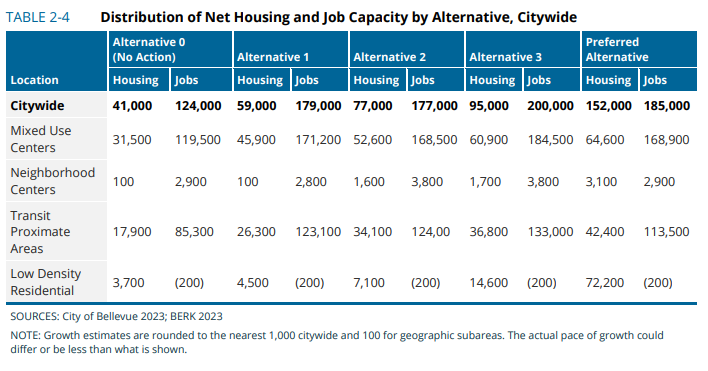
FEIS page 69: “The Preferred Alternative has capacity for about 216,000 housing units, about 152,000 additional capacity for housing units over 2019 housing units and about 111,000 over the capacity under the No Action Alternative. About 47 percent of the additional capacity (and about 61 percent of the capacity over the No Action Alternative) is in low-density residential areas, primarily due to the additional capacity created under HB 1110 and HB 1337.”
The additional density under HB1110/1337 can be compared with the density added in Bellevue’s proposal. First, adding 3 units to most of the ~30,000 “single family” properties results in potential growth of 72,200 units in Low Density Residential areas (see Table 2-4). It is clear that this is not simply 30,000 x 3, so perhaps it takes into account the fact that some areas have covenants or environmentally critical areas, and I think the assumption is that a little more than half of the single family houses become teardowns (Table 2). If we add four more units beyond that with ADUs and a fee-in-lieu option, there would be perhaps an additional 66,300* housing units beyond what was studied under the FEIS, for a total of 138,500 new units in low density areas and 218,300 new units citywide.