As I mentioned in one of my posts about ESC, I think there should be a disclosure of any anticipated sewer connection charges that will need to be paid after the building is occupied. I also had a list of other potential charges that I’ve been collecting over time: “valet” trash pick up, mail/package delivery, utility usage for common areas, technology/connectivity fee, doorknob/lock operation fee, keyfob issuance and replacement fees, pet fees, payment portal fees, tenant portal fees, lease renewal fees, credit bureau reporting fee, lease name change fee, and the duration and cost of the utility connection fee.
When I first started working on this, AI was not a thing, so it’s nice that I was able to plug the list above into Claude, which produced this list:
Move-in / application related
- Application/screening fee
- Move-in administrative fee (separate from application fee)
- Holding fee/deposit to reserve a unit
- Security deposit, and if applicable, deposit-alternative or “surety bond”/deposit-waiver program fees (these are increasingly scrutinized separately)
Recurring monthly charges
- Amenity fee (pool, gym, clubhouse, business center, dog park)
- Resident benefits package fee (often bundles several smaller fees — worth breaking out what’s inside if you use one)
- Parking fee (surface, garage, or reserved spot)
- Storage unit/locker fee
- Trash/recycling fee (distinct from “valet” doorstep pickup)
- Water/sewer/stormwater fee, especially if billed via RUBS (ratio utility billing system) rather than metered
- Pest control fee
- Common area/community fee (landscaping, snow removal, security patrol)
- Insurance requirement — renters insurance mandate, or a liability insurance program fee if the landlord auto-enrolls tenants
- HVAC filter delivery fee (common bundled item)
- Cable/internet/smart-home technology bundle, if distinct from your general “technology/connectivity fee”
Move-out / lease-end related
- Move-out or turnover fee
- Cleaning fee (flat fee vs. deposit-deducted)
- Early lease termination/buyout fee
- Re-key fee at move-out (may overlap with your doorknob/lock fee, but often charged separately at turnover)
Payment-related
- Late payment fee
- NSF/returned payment fee
- Credit card convenience fee (if different from your general payment portal fee — some properties charge ACH free but a % fee for cards)
Other
- Guest fee/additional occupant fee
- EV charging fee
- Bike storage fee
- Gate/garage remote or mailbox key fee (adjacent to your keyfob fee)
- Attorney’s fees/court costs pass-through clause (if your lease allows charging these back to the tenant)
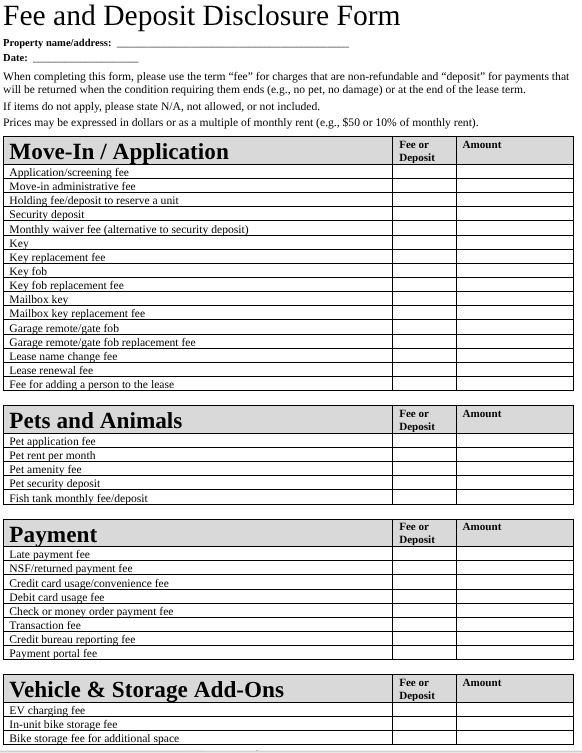
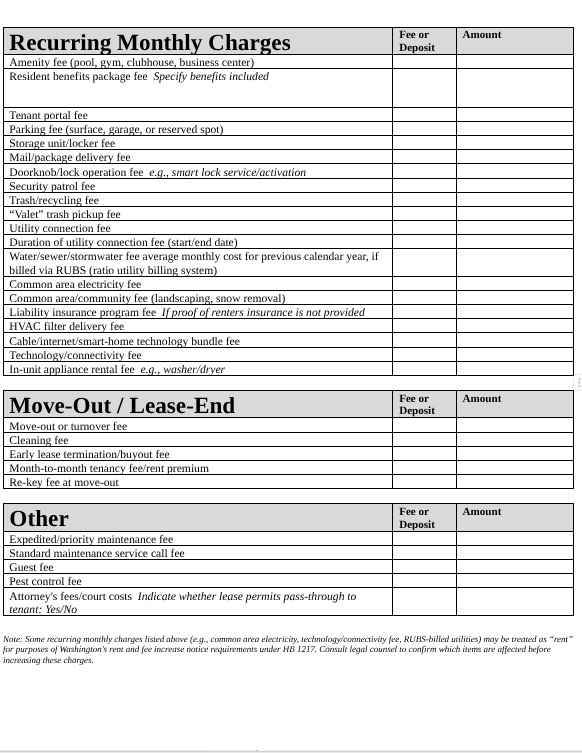
Claude also pointed out the question of whether this should include refundable deposits, which I think it should, since this is intended to help people determine if a particular housing opportunity is affordable to them. The form therefore includes a place to specify whether each item is a fee (non-refundable) or a deposit.
I made more changes and additions to these Claude suggestions (had to add back in some items from the list I provided initially that were left out) and you can see my proposed disclosure form at the bottom of this post.
It’s great to see that in Seattle, there’s a push to address rental ‘junk fees,’ and that they launched a stakeholder process earlier this year. There were even more good suggestions in the Reddit thread about that ST article: management fees, credit building, pet registration fee, credit card/debit card fee/ transaction fee check/money order/app, use of in-unit appliances, RUBS, and pet security deposit.
The existence of a form like this should make it easier to explain which items fall under the HB 1217 cap and 90 day notice requirements, since you’ll be able to just highlight the relevant line items. I also recognize that some items in the list may not be legal to collect fees for, but I think this is a nice place to document that there are no fees for that category, and it should make it easier to notice any discrepancies. I also suspect that there may be forthcoming changes either at the county or state level, and you wouldn’t want to have to update this form to match new rules every time. Ideally this will be used in other jurisdictions too, and it may help focus the policy conversation about what fees should be permissible.
Both the Seattle proposal and this one would require the up-front disclosure of all fees. There are two big differences between Mayor Wilson’s proposal and mine; the Seattle proposal would outlaw certain fees, rather than just making them transparent. I don’t believe we need to eliminate fees when some of the occupants are using more of a resource than others, but perhaps a bunch more people will get pets if it doesn’t change the rent they pay – would that make us a happier city, or would it be more annoying if your neighbors on all sides have animals? The other difference is that as a result of forbidding these existing fees, Seattle’s proposal might functionally lower rents for existing tenants who have pets or are subject to charges for mail or common areas (yes, it wouldn’t take effect until 2027, but the rent increase cap might limit how much the rent line item could be increased to compensate for the removal of these fees). Since this is a renter’s market, it may be one way to bring the total cost paid down to match fair market value. I think they are trying to avoid changing the rules after a lease has been signed, which is sensible unless there’s evidence that a certain category of surprise fees are being added in particularly unexpected ways, but I don’t think you’d need to wait a year for the new rules to take effect if the new requirement is just a disclosure for new and renewing leases. I certainly don’t want to send the message that Bellevue is a difficult place to operate a rental or that this is a place where the laws are constantly changing.
The next step would be to compare this list to existing leases for housing in Bellevue, and see whether it is comprehensive enough to include all things that would be listed in the lease or should have been included in a lease. If you have any time to help, I’d also appreciate feedback on whether the wording is clear and comprehensive enough,and help brainstorming the rules around its use. Should this disclosure be required for existing leases transitioning to month-to-month? Probably not. Should a completed form be required to be posted online when a rental price is advertised? Probably yes.
If you’re curious about the other threads I’ve seen with relevant comments, they’re here: one, two, three, four, five, six
7/9/26 More to add:
Charges owed to the landlord or a third-party provider, including those which have an opt-out option. (should items that can be opted out of be marked in some way?) Price listed for third-party charges should include any margin or administrative charge added by the landlord.
Heat usage
A/C usage
Screening fee (in addition to credit check cost)
Screening or credit check at lease renewal
Move in/lease generation administrative fee (broader wording)
Adding/removing a tenant at the end of the lease term
Adding/removing a tenant during the lease term
Fee for providing community rules
Community management fee
Community space access fee (e.g. pool or laundry, not including a reservation for a private event)
Clarified wording for ESAs vs. pets
Weekend maintenance visit
Utility account setup fee
Utility reading charge
Shared meter fee
Common area utilities may include water
utility account move-out fee
Electronic fund transfer, mail, cash
Check payment or check scan charge
In-person rent payment charge
Phone rent payment charge
Third-party rent payment charge
Multiple installment charge (e.g., money orders)
Late payment notice fee
Notice fees for notices to vacate or eviction-related
Fee for notices which are not valid/unsubstantiated
Monthly administrative fee
High risk fee
Rental application processing
Refundable fee to “hold” an apartment
Non-refundable fee to “hold” an apartment
Lease termination fee
Mail sorting or delivery fee
Package locker fee
Trash or dumpster fee
Inspection fee
Insurance to cover the landlord
Is a particular insurance provider required? Yes/No
Penalty/admin charge for not obtaining your own insurance or providing proof
Insurance validation fee
third-party company deposits
Identity Protection fee
Lease lock fee
Tenant bond fee
Other administrative charge
Other concierge services
Other convenience charge
Number of months in the previous calendar year for which there was a pest control charge.
Eviction fee or attorney fee or legal fee in addition to court costs
Some of the above items are from the National Consumer Law Center’s Too Damn High report, which also had the following notes of interest.
“A Nebraska advocate stated that landlords started charging administrative fees for cooperating with the Emergency Rental Assistance Program”
“A Washington advocate commented that landlords charge one-time administrative fees of several hundred dollars at the time the tenancy starts.”
“A New York advocate described how when one corporate landlord took over a property that was formerly public housing it began charging a parking fee but failed to provide accessible parking spots.”
“A Texas advocate stated that landlords charge a move-out deposit of $500 in cash, which is separate from the original security deposit.”
“A New Mexico advocate reported that apartment managers sometimes charge an estimated court filing fee on non-rent cases (for more than the actual cost), which is not included in the lease agreement… A Maryland advocate noted that landlords charge court costs even when the landlord does not file the eviction case because the tenant pays the past due rent. Similarly, a California advocate noted that a landlord charged the cost of their legal fees to file an unlawful detainer action that was dismissed immediately because the tenant had complied with the relevant notice requirement.”
“A Washington advocate reported that landlords charge tenants for semiannual inspections that the landlord performs.”
“A Minnesota advocate reported that leases require renters to pay $25 to $35 per month to a utility company program that provides maintenance to furnaces and appliances that the landlord owns.”
Are there lessons learned from the Belliingham and Minnesota disclosure requirements (when advertised, or prior to collection of an application fee)? Colorado’s HB25-1090 also requires advertisement of a single “total price.” Virginia’s HB 2430 requires fees to be listed on the front page of the lease, which doesn’t work with a list this comprehensive (side note: there is probably a minimum font size that’s required for a form like this, so it may end up being even more pages in its final form).
Minnesota also requires summing the non-optional fees to create a Total Monthly Payment line item (page 12), but it would take a user design mindset to incorporate that into the form in a way that’s clear and unambiguous.
Would a rental housing association/advocacy organization be interested in filling out a standard version that smaller landlords can use as a template? Hopefully they’d at least identify the items which are not legal to charge for (either completely prohibited or only allowed when there’s an opt-out) and communicate that to their members.
There was also this appendix to the NCLC report with a comparison of policies in various states:
- Would add a prohibition on charging a screening fee when no unit is available.
- I like Virginia’s approach to making late fees proportional to the portion of the rent that’s unpaid, since it gives tenants an incentive to pay what they can.
- Utah has a nice disclosure before accepting application fee, though I’m not sure what is included in their item 5.
Leave a Reply